
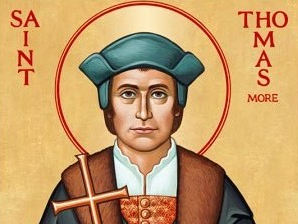
I’ve enjoyed reading about the life of St. Thomas More, in, Saint Thomas More: Selected Writings (New York: Vintage Spiritual Classics, 2003). I enjoy the preface to the book, written by the Jesuit, Joseph W. Koterski. In the preface, Koterski gives us a concise and to-the-point outlook and overview of the significance of St. Thomas More’s life. His analysis of the “judgments of conscience” is most striking.
Some background about the life of St. Thomas More is in order. St. Thomas More (1478-1535) was a scholar, lawyer, statesman, humanist and, most importantly, a martyr. More lived in England during a time of the “new learning” in Europe. As a friend of the remarkable Dutch humanist, Desiderius Erasmus, More contributed greatly to the new trend in learning of his day. His literary works (e.g., Utopia and The Sadness of Christ) showcase an understanding of a wide range of theological and philosophical subjects. As a common lawyer, More ascended to the highest levels of diplomacy in England during the reign of King Henry VIII. Sadly, More was executed by Henry VIII in 1535 because of his silence on the issue of Henry VIII’s obtaining a divorce from Catherine of Aragon, so to marry his mistress, Anne Boleyn, which, according to Koterski, involved “a question of a truth based on revelation and the determination of authority [by the Roman Pontiff]” (xii, xvii). More’s trial was tense, to say the least. It is supposed that More was eventually charged with treason only because Sir Richard Rich (1496-1567), a prominent lawyer himself, committed perjury. Notwithstanding, once More was charged with treason, he chose to no longer keep silent about the issues surrounding his sentencing, and so he discharged his views about Henry VIII’s actions and the sentencing thereof. More’s “stance” at trial still serves as a remarkable testimony to truth and law. He is reported to have said:
And forasmuch as this Idictment is grounded upon an Act of Parliament directly repugnant to the laws of God and his Holy Church, the supreme Government of which, or of any part whereof, may no temporal Prince presume by any law to take upon him, as rightfully belonging to the See of Rome, a spiritual pre-eminence by the mouth of our Saviour himself, personally present upon earth, only to St. Peter and his successors, Bishops of the same See, by special prerogative granted; it is therefore in law, amongst Christians, insufficient to charge any Christian man. (xiii)
On a spring day in 1535, More was executed. At his execution, he is recorded to have said: “I die the king’s good servant but God’s first.” He then knelt down, prayed the Miserere (Psalm 51), kissed his executioner in “an act of forgiveness,” and succumbed to the swift blow of the executioner’s ax (lxiv). More was canonized in 1935 by Pope Pius XI in Saint Peter’s Basilica. Pius praised More as an example of “Christian fortitude” and described him as a “star of sanctity that traced a luminous path across that dark period of history” (lxvi). St. Thomas More’s patronage in the Catholic Church includes lawyers, statesman and politicians. He stands as an witness to law, truth, wisdom and knowledge amidst the fiery trials of martyrdom, and he stood for it all in the face of tremendous political adversity.
But how did he “stand” for it all?
It is said that the Protestant reformer, Martin Luther, dictated two sources by which he would relegate himself to a trial by authority: (1) by testimony of Holy Scripture; and (2) by his own conscience. Thomas More is said to have done so by two related sources: (1) by the authority of Christ’s Holy Roman Catholic Church; and (2) by the “inner seat of reasoning and judgment about moral matters” (xv). On account of both of these sources, More stood before the world-court with a formed conscience, a conscience that exercised “proper authority and reason’s discovery of the natural law” (xv). Indeed, he stood before the world-court with a strong conscience: a conscience that did not spurn the testimony of Holy Scripture, but one which lived in Scripture like a great man lives amid the many voices of a doctor’s sacred tome.
Thomas More appears as someone with an uncommon sense of wisdom with respect to law, Scripture, and the governance thereof. His uncommon sense of wisdom was due to his early formation. More spent time with members of the Carthusian Order in his youth, and so he participated in the monks’ spiritual exercises of meditation and prayer (xxxvii). He also read St. Thomas Aquinas on the judgments of conscience: i.e., a three-fold exercise that More could use in conjunction with Carthusian spiritual exercises. The three-fold division of the judgments of conscience includes:
(1) The recognition that we have done or have not done something (in this regard, conscience is said to be a witness);
(2) the judgment that something should be done or should not be done (here conscience binds and incites us to some action); and
(3) the judgment that something is well done or ill done (thus conscience is said to excuse, accuse, or torment us). (xv)
The first of these judgments of conscience may be known to many, to Christians in particular, as an “examination of conscience.” It is important to note that the first step of the judgments of conscience, (“the recognition that we have done or have not done something”), is not the same as steps two and three of the same. In step two, there is a judgment done to the conscience. As such, step two is not strictly identical to recognition or examination, as step two (and three) is more what is done about the state of conscience. In other words, examination or recognition of conscience is not in-itself a formal judgment that something must be done to absolve someone from the state of conscience they find themselves in. It is, rather, a necessary step in bearing out an actual judgment upon the conscience. The judgments of conscience in the second step are those judgments bearing down on the conscience to act, convicting it, accusing it, tormenting it, binding it, inciting it, and so on. The judgments of the third step are those judgments which grant the conscience affirmation or negation with respect to the action taken to absolve.
We would all do well to transition from merely examining or recognizing our conscience to actually judging it. If we “delight in the law of God in your inmost self” (Rom 7:22), we should make More’s exercise our own. And as this sort of exercise is what Martyrs and Saints are made of, we couldn’t begin with it soon enough.
REFERENCES
All in-text citations found in:
Thornton, Varenne (Eds.) (2003). Saint Thomas More: Selected Writings. New York: Vintage Spiritual Classics. Print.
Citations from Holy Scripture according to the New Revised Standard Version (NRSV).
 Dr. Lance H. Gracy
Leave a charitable reply!